For decades, designers were the ones who imagined spaces. Today, anyone can generate an image in seconds.
Just a few years ago, creating a realistic visualization of a project required hours of work.
- 3D Modeling.
- Rendering.
- Corrections.
- Post-production.
Today, simply writing a few lines in an Artificial Intelligence tool is enough to obtain amazing images in a matter of seconds.
It's natural for the question to arise: Will designers still be necessary?
The short answer is yes. But the interesting answer is much deeper. Artificial intelligence isn't replacing design. It's forcing us to redefine what it truly means to design.
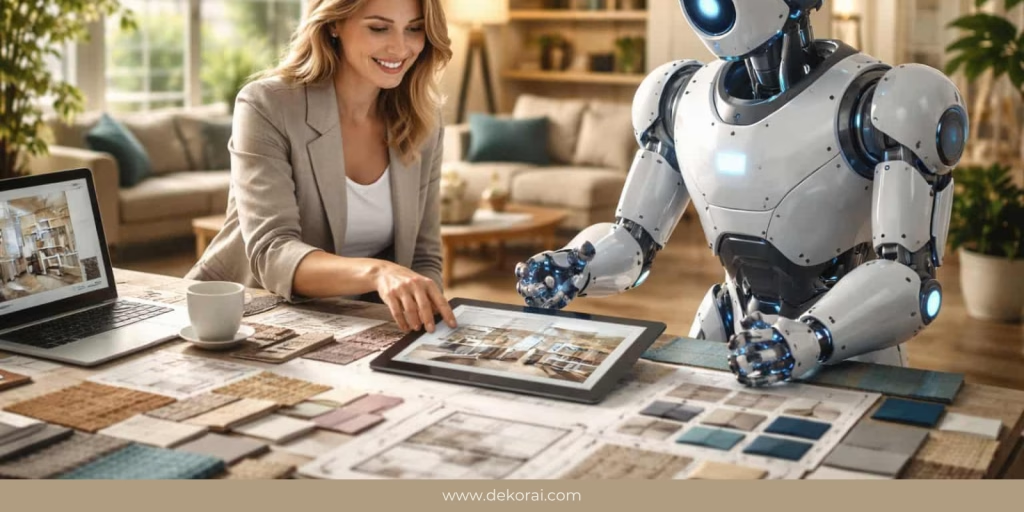
We confuse producing images with designing
An attractive image is not a project. It may seem obvious. But we often forget that difference.
Designing involves understanding constraints.
- Budget.
- Family needs.
- Accessibility.
- Regulations.
- Lightning.
- Materials.
- Construction.
- Sustainability.
- Execution.
- Relationship between all those elements.
AI can generate thousands of suggestions. But it still needs someone to ask the right questions.
Autodesk summarizes this idea very clearly: the true potential of AI emerges when a professional correctly defines the objectives, constraints, and scenarios that the tool should explore. The technology amplifies the designer's work; it doesn't replace it.
History shows that tools do not eliminate good professionals.
When CAD appeared, many thought technical drawing would disappear. Something similar happened when BIM modeling emerged. The same occurred with real-time rendering.
However, none of those technologies eliminated the profession.
- The tasks changed.
- They reduced the time spent on repetitive processes.
- And they allowed professionals to dedicate more time to analysis, creativity, and strategy.
Artificial Intelligence represents the next stage of that evolution.
The first thing to disappear won't be the designers
- Repetitive tasks will disappear.
- Looking for references for hours.
- Generate multiple variations of the same environment.
- Change colors.
- Test different distributions.
- Create preliminary renders.
- Classify products.
- Compare materials.
All of that can be increasingly automated.
Various studies on AI applied to design show precisely this scenario: AI accelerates the exploration of alternatives and increases productivity, allowing more time to be dedicated to activities of greater creative value.

The real work of the designer begins where AI ends.
Let's imagine two families. Both have a house of 120 square meters.
The same budget and the same favorite decorating style. However, their projects will likely be completely different. Why? Because people are different.
- A family works from home.
- The other one receives visitors constantly.
- One has young children.
- The other one needs accessible spaces for a senior citizen.
Understanding those differences requires conversation.
- Empathy.
- Listen.
- Interpretation.
AI can analyze data. But deeply understanding a person remains an essentially human ability.
The designer of the future will be less of an operator and more of a strategist.
The biggest transformation won't happen in the tools. It will happen in the professional role. Designers will spend less time producing images, and much more time understanding people.
- Building concepts.
- Interpreting emotions.
- Designing experiences.
- Coordinate specialists.
- Making complex decisions.
Each technological revolution increases the value of that which cannot be easily automated. In design, that means discernment.
Creativity doesn't disappear. It just changes level.
There is a misconception that AI is "creative." In reality, AI combines learned patterns.
It can generate thousands of alternatives. But it has no personal experiences.
- He doesn't understand the emotional context of a family.
- He doesn't understand memories.
- He does not interpret silences.
- It does not build meaning.
Human creativity consists precisely of connecting information with culture, emotions, intuition, and purpose. AI accelerates the creative process, but the direction remains human.
Customers will continue to need trust.
Designing a home involves important decisions. It's not enough to just create a pretty picture.
A decision must be made.
- Invest.
- Build.
- Coordinate.
- To resolve unforeseen problems.
Customers will continue to seek professionals capable of guiding them through that process.
Trust isn't automated. It's built. And it will likely become one of the greatest assets for designers of the future.
Artificial intelligence will democratize design
There is another very positive effect. AI will allow many more people to access design tools. This will expand the market. More people will experiment with their spaces, and more projects will reach stages where professional support is needed.
Far from reducing opportunities, technology can increase demand for higher-value specialized services.
Recent research on AI applied to interior design highlights precisely this potential: democratizing access to personalized design while strengthening collaboration between people and intelligent systems.
The right question is not who will be replaced.
The real question is something else. What kind of designer do you want to be?
Those who compete solely to generate renders will likely face greater pressure.
Those who contribute strategic vision, human understanding, and the ability to transform needs into experiences will have more opportunities than ever before.
A professor and consultant specializing in interior design summarizes this transformation by noting that business models focused solely on selecting furniture are losing relevance, while the value of those who provide deep customer understanding, specialization, and personalized design is growing.
Conclusion
Artificial intelligence will profoundly change the design profession. But changing a profession doesn't mean eliminating it. It means elevating it.
- The tools will automate repetitive tasks.
- Human creativity will become more valuable.
- Empathy will be more important.
- Strategy will carry more weight.
And understanding how people want to live will remain an ability that is impossible to completely replace.
Perhaps in a few years we will stop talking about “AI-assisted design.” We will simply talk about design.
Because Artificial Intelligence will be just another tool, and the real value will continue to lie with those who know how to use it to improve people's lives.
Frequently Asked Questions (FAQs)
Will AI replace interior designers?
Current evidence indicates that it does not. AI automates repetitive tasks and accelerates creative processes, but strategic design, empathy, and understanding human needs continue to depend on professionals.
What tasks can Artificial Intelligence perform?
Generating renders, exploring alternatives, visualizing spaces, product recommendations, preliminary analysis, and automating repetitive processes.
What skills will be most important for designers?
Empathy, strategic thinking, creativity, communication, project leadership, understanding of human behavior, and the ability to integrate technology with design.
Will AI increase or decrease the demand for designers?
Everything indicates that it will transform demand. Operational tasks will decrease, and the value of professionals capable of offering customized and strategic solutions will increase.
How can a designer prepare for this change?
By incorporating AI tools into their workflow, strengthening human skills that are difficult to automate, and positioning themselves as a strategic advisor rather than just an image producer.
References
The future of design will be more human thanks to AI
At DekorAI we believe that Artificial Intelligence is not meant to replace interior designers.
It frees up your time from repetitive tasks so you can focus on what's truly important: understanding people, creating memorable experiences, and designing spaces that improve quality of life.
Our platform uses AI to accelerate visualization, personalize proposals, and facilitate decision-making, becoming an ally for professionals, retailers, and consumers.
Because the best design doesn't come from a tool, it comes from understanding how people want to live.
Explore more articles about Artificial Intelligence, interior design and the future of the home on our blog.
👉 https://dekorai.com/blog
Do you want to discover how AI can enhance your work or transform your customers' shopping experience?
Meet DekorAI:
👉 https://dekorai.com/
Follow us to learn about the latest trends in Artificial Intelligence applied to the home, design, and retail.


 Español de Chile
  Português do Brasil
 English
